

'The Beautiful Lie': New Book by Attorney, Economist, and CPA, Frank Igwealor Argues That Socialism Fails by Design
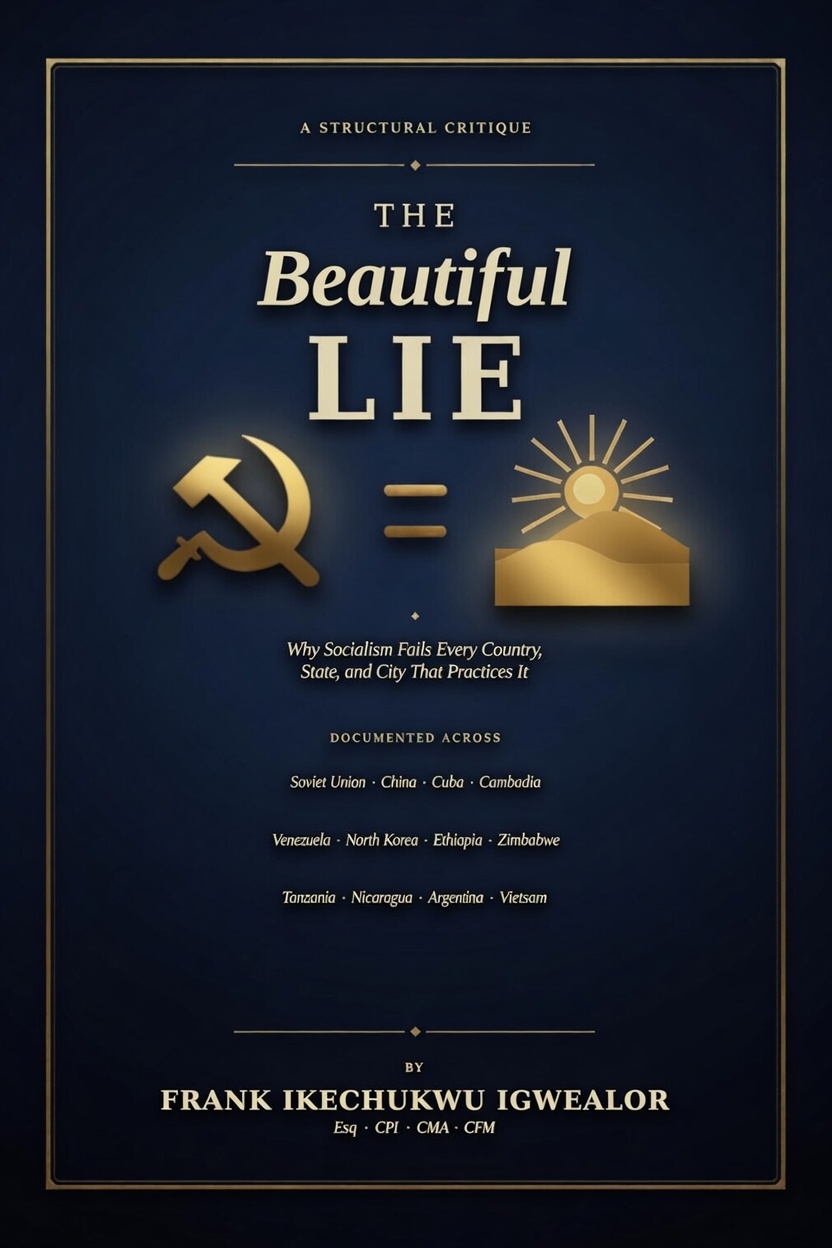
The Beautiful Lie
Why Socialism Fails Every Country, State, and City That Practices It traces more than a century of evidence, from the Soviet Union and Maoist China to Venezuela
LOS ANGELES, CA, UNITED STATES, September 10, 2026 /EINPresswire.com/ -- THE BEAUTIFUL LIE: New book traces more than a century of evidence, from Soviet bread lines and Mao’s famine to Venezuela’s collapse and America’s struggling cities, and makes the case for the institutions that actually produce prosperity.Socialism has never lacked for noble promises. The Soviet Union promised abundance to exhausted workers. Maoist China promised dignity to humiliated peasants. Cuba promised liberation, Venezuela promised justice for the poor, and Tanzania promised a brotherhood rooted in the African village. In case after case, what arrived instead was repression, scarcity, corruption, and, too often, mass death.
In The Beautiful Lie: Why Socialism Fails Every Country, State, and City That Practices It, Los Angeles attorney, economist, and certified public accountant Frank Ikechukwu Igwealor asks the question that more than a century of this record demands: how does a doctrine that promises so much good produce so much harm, so consistently, across so many different cultures? His answer is direct. The failures are not accidents of implementation. They are built into the doctrine itself.
“When the same doctrine produces the same result in Russia, China, Cambodia, Cuba, Ethiopia, and Venezuela, the cause cannot be local to any of them,” said Igwealor. “The differences are the variables. The recurring outcomes are the constants. Socialism is not a sound idea that keeps getting undermined by bad implementation. The doctrine is the source of the failures.”
A Structural Diagnosis, Not a Slogan
The Beautiful Lie is written for readers who have heard the most common modern defense of socialism: that the Soviet Union, Maoist China, and Venezuela were not “real socialism,” and that the true version has never been tried. Igwealor takes that argument seriously and then dismantles it. The regimes he examines drew on the same theorists and built the same institutions: state ownership of major industries, central planning, restrictions on private enterprise, suppression of independent unions and media, and limits on emigration. That those institutions produced similar results in societies with different religions, geographies, colonial histories, and leaders is, he argues, the strongest evidence that the system, not local circumstance, drove the outcome.
Igwealor brings an unusual combination of training to the subject. As a CPA, he approaches nationalization the way an auditor approaches any large transfer of value, asking what actually happened to the assets once the state took them. As an economist and attorney, he traces how the erosion of property rights leads to the erosion of the rule of law. The result reads less like a polemic than like a case file assembled for a jury, with sources discussed openly and ranges given where the historical record is uncertain.
Why This Book, Why Now
The book arrives as ideas once confined to the margins of American politics have returned to the mainstream, often presented to young voters as untested and new. Igwealor argues that they are neither. He points to a longer American trend: steady growth in the federal government’s share of the economy, in federal debt, in the volume of federal regulation, and in the share of workers who need a government license to earn a living. None of this makes the United States a socialist country, and the book does not claim that it does. The argument is that direction matters, and that a society which forgets where the road leads is poorly placed to judge how far down it to travel.
That is why the book is built on evidence rather than slogans. Igwealor draws on United Nations investigations, Forbes wealth estimates, U.S. Treasury sanctions records, defector memoirs, demographic reconstructions, and the testimony of survivors. An Author’s Note on Sources explains where the record is firm and where it varies, and the book gives ranges rather than false precision when historians disagree about specific figures. The structural patterns, Igwealor argues, are reliable even where individual numbers are contested.
Inside the Book
The book runs 97 chapters across twelve parts, and each part advances a single cumulative argument.
Part I sets out the gap between socialist rhetoric and socialist reality, examines how the doctrine claims the moral high ground while destroying individual agency, contrasts equality of opportunity with forced equality of outcome, and draws the distinction the rest of the book depends on: the difference between a market economy with a welfare state and a genuinely socialist state. Part II addresses a claim heard from pulpits and campuses alike, that the early church described in the Acts of the Apostles practiced socialism. Igwealor walks carefully through the text, including the account of Ananias and Sapphira, and shows that the Jerusalem believers gave voluntarily from property that remained theirs to keep. The early church, he concludes, practiced charity, not state coercion.
Part III lays out the mechanism. Drawing on Ludwig von Mises’s 1920 argument about economic calculation and on Friedrich Hayek’s work on dispersed knowledge, Igwealor explains why planners without real market prices cannot allocate resources rationally, why effort collapses when reward is severed from work, and why central planning requires concentrated power, which in turn requires the suppression of information and dissent. Price controls produce shortages, shortages produce black markets, and scarcity becomes a normal feature of daily life.
Parts IV and V make the moral and economic case. Igwealor argues that expropriation is robbery regardless of the legal form it takes, and documents how nationalization tends to destroy value rather than transfer it. He shows how socialist systems wage war on entrepreneurs, turn citizens into petitioners, and sustain a permanent crisis economy that always needs a scapegoat. One of the book’s most compelling chapters treats Vietnam as a natural experiment: the same country, the same people, and the same ruling Communist Party before and after the 1986 Doi Moi market reforms. Before the reforms, a nation that had once exported rice was importing it. After them, per-capita income multiplied many times over and Vietnam became one of the world’s largest rice exporters.
Part VI turns to politics and law. Where the state holds unlimited power to take, redistribute, permit, and forbid, Igwealor writes, the rule of law gives way to the rule of decision. Courts become political instruments. Opposition is suppressed. Leaders who promised to serve the people harden into a ruling class, every question becomes political, and a bureaucratic maze of permits, approvals, and paperwork grows up around ordinary citizens who have no independent recourse against it. Corruption does not disappear under the banner of equality; it simply changes hands. The part closes by returning to the Acts of the Apostles and tracing the long road from voluntary community to modern ruins.
Equality for the Many, Fortunes for the Few
Part VII documents what Igwealor calls socialism’s elite enrichment machine. The book examines the Castro family, drawing on Forbes estimates, U.S. Treasury records, and the memoir of Fidel Castro’s longtime personal bodyguard; the families and inner circles around Hugo Chávez and Nicolás Maduro; the Mugabes of Zimbabwe; and the Soviet nomenklatura. The pattern repeats in every case. Revolutionaries who condemned the old aristocracy became a new one.
“The system that promises to take from the rich and give to the poor instead takes from the productive and gives to the politically connected,” said Igwealor. “The rich are not abolished. They are replaced by a new class with a different credential. The poor are used as the justification, and the benefits flow upward.”
The Historical Record
Part VIII walks eleven national cases through the same analytical template: the Soviet Union, Maoist China, Eastern Europe, Cuba, North Korea, Cambodia, Zimbabwe, Venezuela, Tanzania, Nicaragua, and Argentina. The chapters cover Mao’s Great Leap Forward famine, the largest peacetime famine in history; Cambodia’s killing fields, which claimed roughly a quarter of the population in under four years; Tanzania’s forced villagization; and Zimbabwe’s fall from regional agricultural exporter to dependence on food aid.
Venezuela, which holds the world’s largest proven oil reserves, receives particular attention as the most recent and concentrated example. After the nationalizations and purges of the Chávez and Maduro years, the country’s oil production fell from about 3.2 million barrels per day in 1998 to below 400,000 by 2020, and millions of Venezuelans fled. Argentina, whose per-capita income around 1913 was comparable to France’s, is examined as a warning of how even partial adoption of socialist policies, including expropriation, nationalization, and currency controls, can drag a wealthy nation into a century of relative decline.
Closer to Home
Part IX brings the analysis to American and European cities and states, where readers can test the argument against what they see around them. Igwealor examines Detroit’s decline from the nation’s fourth-largest city, California’s housing and cost-of-living pressures, heavily regulated public education, rent control, and unfunded public pension liabilities. He is careful to note that these places are not Venezuela and that forces such as deindustrialization played real roles. His argument is that the same institutional patterns, applied at smaller scale, push outcomes in the same direction.
Why the Idea Keeps Coming Back
If the record is this consistent, why does socialism keep winning new converts? Part X examines the appeal of moral certainty, the incentive structures within academia and journalism, resentment politics that treats success as suspect, and what Igwealor calls generational forgetting. The collapse of the European socialist regimes in 1989 is now more than three decades past, and a growing share of voters have no personal memory of it.
He also confronts the persistent claim that the Nordic countries prove socialism works. Denmark, Sweden, Norway, Finland, and Iceland, he shows, are market economies with substantial redistribution through taxes and transfers, and several rank ahead of the United States on international indexes of economic freedom. Norway’s oil wealth, examined later in the book, has been preserved through a disciplined sovereign wealth fund rather than state control of the economy.
“Every generation meets socialism as a fresh promise, without the memory of what it cost the last one,” Igwealor said. “I wrote this book so that the memory is not lost, and so that the next generation can weigh the promise against the full record before deciding.”
The Human Cost
Part XI turns from analysis to people, in three chapters devoted to the dead, the survivors, and the unborn. Igwealor draws on the widely cited aggregate estimate, associated with The Black Book of Communism, of roughly 100 million deaths under twentieth-century communist regimes, while noting that component figures remain debated at the margins. The survivors chapter revisits witnesses such as Aleksandr Solzhenitsyn, arrested in 1945 for criticizing Stalin in a private letter, whose testimony helped the world understand the Soviet camp system. Igwealor also examines demographic reconstructions of the generations that were never born. The goal, he writes, is to keep the scale of the loss in view before anyone treats the doctrine as a mere abstraction. The appendices add statistical comparisons, famine documentation, leader-wealth records, and a reading list of memoirs and survivor testimony.
The Alternative
The Beautiful Lie does not end in critique. Part XII makes the constructive case for the institutions that have produced sustained prosperity across very different cultures: secure property rights, voluntary exchange and free markets, sound money, protection for enterprise and entrepreneurs, well-governed sovereign wealth institutions, and a constitutional rule-of-law framework. The final chapter of that part addresses the work of defending and maintaining those institutions, which Igwealor argues no generation can take for granted.
The sovereign wealth chapter is a good example of the book’s constructive approach. It contrasts resource-rich countries that squandered their windfalls, including Venezuela and Angola, with those that turned natural wealth into lasting prosperity through transparent, rules-based institutions, most notably Norway’s Government Pension Fund Global, along with Singapore and, at smaller scale, the Alaska Permanent Fund. The lesson, Igwealor argues, is that resources do not determine outcomes. Institutions do.
The book closes with “The Old Lie in New Clothes,” which traces how the same promise has returned in Bolshevik, Maoist, Castroist, and Chavista dress, and now in the language of twenty-first-century American politics.
“The clothing the lie wears changes from one generation to the next,” said Igwealor. “The lie itself does not.”
Who Should Read It
The Beautiful Lie is written for students encountering socialist ideas on campus and online; voters weighing proposals for price controls, rent control, nationalization, and expanded state direction of the economy; pastors and people of faith who have heard the Acts of the Apostles invoked in political debate; educators, journalists, and policy professionals looking for a single documented reference; and parents who want their children to understand the historical record before they inherit the argument. Its self-contained chapters also make it well suited to book clubs, church study groups, homeschool curricula, and university reading lists.
Book Details
Title: The Beautiful Lie: Why Socialism Fails Every Country, State, and City That Practices It
Author: Frank Ikechukwu Igwealor
ISBN: 979-8-9961136-6-8
Formats: Paperback, Kindle, and Audiobook
Price: $19.99
Available at:
Amazon: www.amazon.com/dp/B0H3BL6N2P
ElevenReader: https://elevenreader.io/audiobooks/the-beautiful-lie-audiobook/pj_tUeaNIVLMzKBPpRIJHu2
About the Author
Frank Ikechukwu Igwealor is an economist, a California-licensed attorney, a Certified Public Accountant, a Certified Management Accountant, and a Certified Financial Manager. He has also been a California-licensed real estate broker since 2005. His education includes degrees in accounting, economics, business administration, risk management, and law. Based in Los Angeles, he has served as an officer and director of public and private companies in the United States, Europe, Asia, the Middle East, and Africa, and he pastors a small congregation in Los Angeles.
Igwealor has written more than 20 books on economics, philosophy, politics, faith, finance, and the stock market. His other titles include The Roots of African Poverty, African Development Paradox, Failure Intelligence, The Fallacy of Reciprocity of Generosity, The God of Abraham, Isaac and Israel, 10X Stock Finder, and Momentum Investing Cheat-Code.
Available for Interviews
Igwealor is available for print, broadcast, and podcast interviews. Suggested topics include why “real socialism has never been tried” fails as a defense, whether the Acts of the Apostles describes socialism, the common misreading of the Nordic model, what Venezuela’s collapse teaches the world, what Vietnam’s reforms reveal about markets, and what American cities and states can learn from the global record.
Media Contact
Frank Igwealor
Frank Ikechukwu Igwealor
Frank Ikechukwu Igwealor
email us here
Legal Disclaimer:
EIN Presswire provides this news content "as is" without warranty of any kind. We do not accept any responsibility or liability for the accuracy, content, images, videos, licenses, completeness, legality, or reliability of the information contained in this article. If you have any complaints or copyright issues related to this article, kindly contact the author above.
